The Fall of China’s Qing Dynasty in 1911
By Kallie Szczepanski
The ethnic-Manchu rulers of China’s Qing Dynasty reigned over the Middle Kingdom from 1644 CE until the early 20th century. What brought about the collapse of this once-mighty empire, ushering in the modern era in China?
The collapse of China’s Qing Dynasty was a long process. Qing rule gradually collapsed during the second half of the nineteenth century and the early years of the twentieth, due to a complex interplay between internal and external factors.
External Factors:
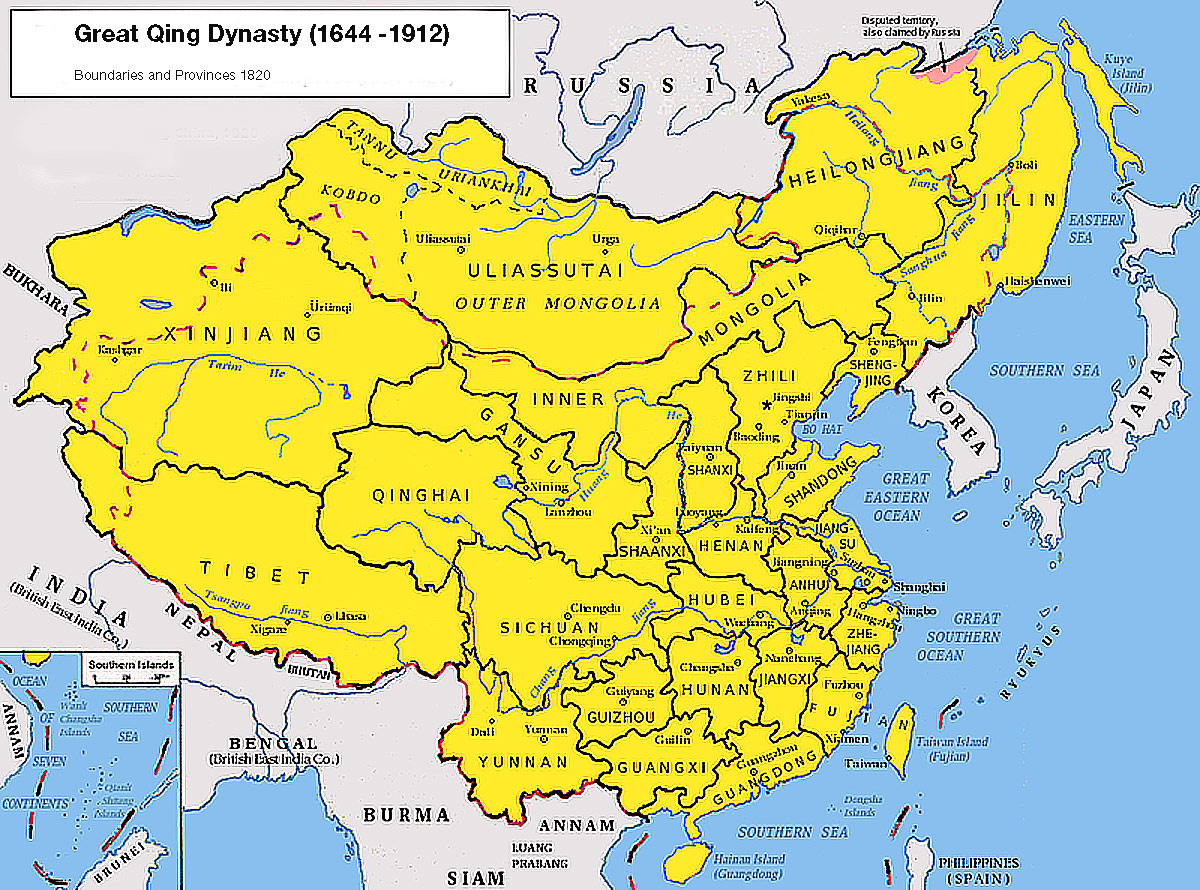
Europe’s leading countries expanded their control over large portions of Asia and Africa in the late nineteenth and early twentieth centuries, putting pressure even on the traditional superpower of East Asia, imperial China. The most devastating blow came in the Opium Wars of 1839-42 and 1856-60, after which Britain imposed unequal treaties on the defeated Chinese and took control of Hong Kong. This humiliation showed all of China’s neighbors and tributaries that the once-mighty China was weak and vulnerable.
With its weakness exposed, China began to lose power over peripheral regions. France seized Southeast Asia, creating its colony of French Indochina. Japan stripped away Taiwan, took effective control of Korea (formerly a Chinese tributary), and also imposed unequal trade demands in the 1895 Treaty of Shimonoseki.
By 1900, foreign powers including Britain, France, Germany, Russia and Japan had established “spheres of influence” along China’s coast – areas in which the foreign powers essentially controlled trade and the military, although technically they remained part of Qing China. The balance of power had tipped decidedly away from the imperial court and toward the foreign powers.

Internal Factors:
While external pressures chipped away at Qing China’s sovereignty and its territory, the empire also began to crumble from within. Ordinary Han Chinese felt little loyalty to the Qing rulers, who were Manchus from the north. The calamitous Opium Wars seemed to prove that the alien ruling dynasty had lost the Mandate of Heaven and needed to be overthrown.
In response, the Qing Empress Dowager Cixi clamped down hard on reformers. Rather than following the path of Japan’s Meiji Restoration, and modernizing the country, Cixi purged her court of modernizers.
When Chinese peasants raised a huge anti-foreigner movement in 1900, called the Boxer Rebellion, they initially opposed both the Qing ruling family and the European powers (plus Japan). Eventually, the Qing armies and the peasants united, but they were unable to defeat the foreign powers. This signaled the beginning of the end for the Qing Dynasty.
The crippled Qing Dynasty clung to power for another decade, behind the walls of the Forbidden City. The Last Emperor, 6-year-old Puyi, formally abdicated the throne on February 12, 1912, ending not only the Qing Dynasty, but China’s millennia-long imperial period.




 新加坡清史研究学会