清史网成立读书会
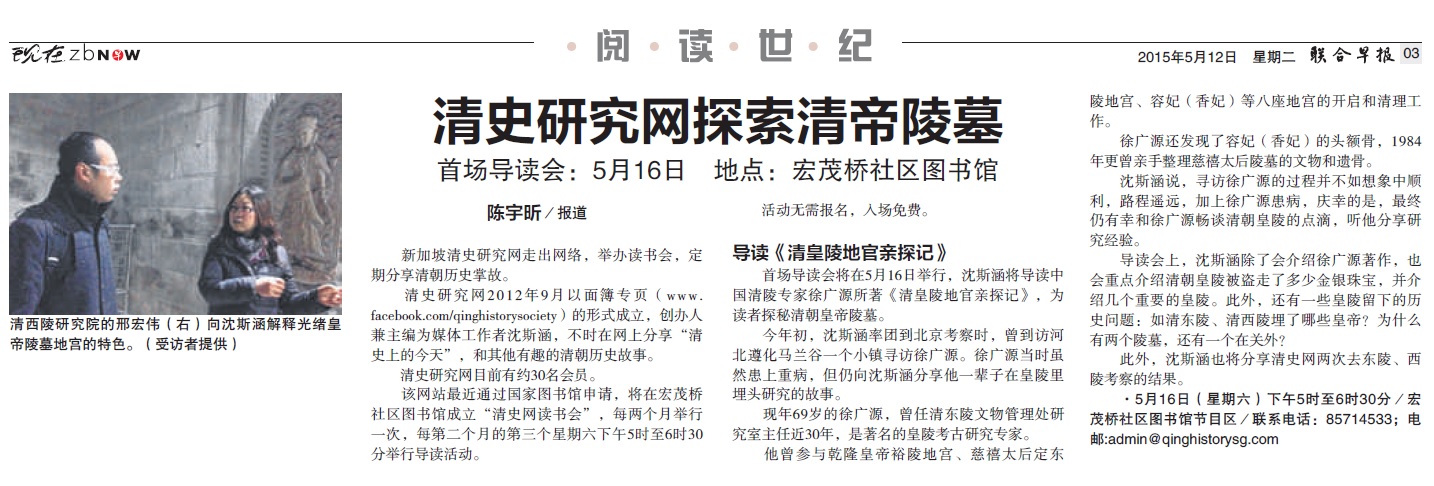
为了提倡本地阅读活动及加深大家对清朝历史的认识,新加坡清史研究网和国家图书馆及宏茂桥图书馆取得联系后,将在宏茂桥图书馆成立清史网读书会。
清史网读书会每两个月举行一次,第二个月的第三个星期六下午5点至6点30分,假宏茂桥图书馆举行导读活动,并将会在活动前一个月通过清史网网站及Facebook专页通知会员及公众,请大家踊跃参加,无需报名,入场免费。
清史网读书会将在下个月,即5月16日举行第一场读书会,主题为:“清朝皇帝陵墓探秘”,导读的书籍是由清陵专家徐广源先生撰写的《清皇陵地宫亲探记》。

关于导读者:沈斯涵,新加坡人,1984年生,现任新加坡清史网主编,曾带领清史网考察团远赴清东陵及清西陵进行参访,目前是新传媒时事节目编导,也是新加坡作家协会财政、新加坡宗乡会馆联合总会学术委员,刚出版了诗集《睹物斯人》。
关于作者:徐广源,满族,河北省遵化市人,1946年生。现任中国紫禁城学会理事。从上世纪七十年代初开始研究清陵。担任清东陵文物管理处研究室负责人近30年。参加过乾隆帝裕陵地宫、慈禧陵地宫、容妃(香妃)地宫、纯惠皇贵妃地宫的开启清理工作。亲身探过8座清陵地宫。是他找到了容妃(香妃)的头颅骨。1984年亲手整理过慈禧的遗体。
30多年来一直从事清陵和清代后妃的研究。他是国家自然科学基金资助项目《明清皇家陵寝综合研究》专家组成员。是我国清陵研究的权威专家。其专著有《清东陵史话》、《清西陵史话》、《清东陵》、《清西陵》、《清朝皇陵探奇》、《解读清皇陵》、《正说清朝十二后妃》、《正说清朝十二帝陵》、《清皇陵地宫亲探记》、《大清皇陵》。发表学术论文60多篇。其事迹被90多部辞书所收录。
The Fall of China’s Qing Dynasty in 1911
The Fall of China’s Qing Dynasty in 1911
By Kallie Szczepanski
The ethnic-Manchu rulers of China’s Qing Dynasty reigned over the Middle Kingdom from 1644 CE until the early 20th century. What brought about the collapse of this once-mighty empire, ushering in the modern era in China?
The collapse of China’s Qing Dynasty was a long process. Qing rule gradually collapsed during the second half of the nineteenth century and the early years of the twentieth, due to a complex interplay between internal and external factors.
External Factors:
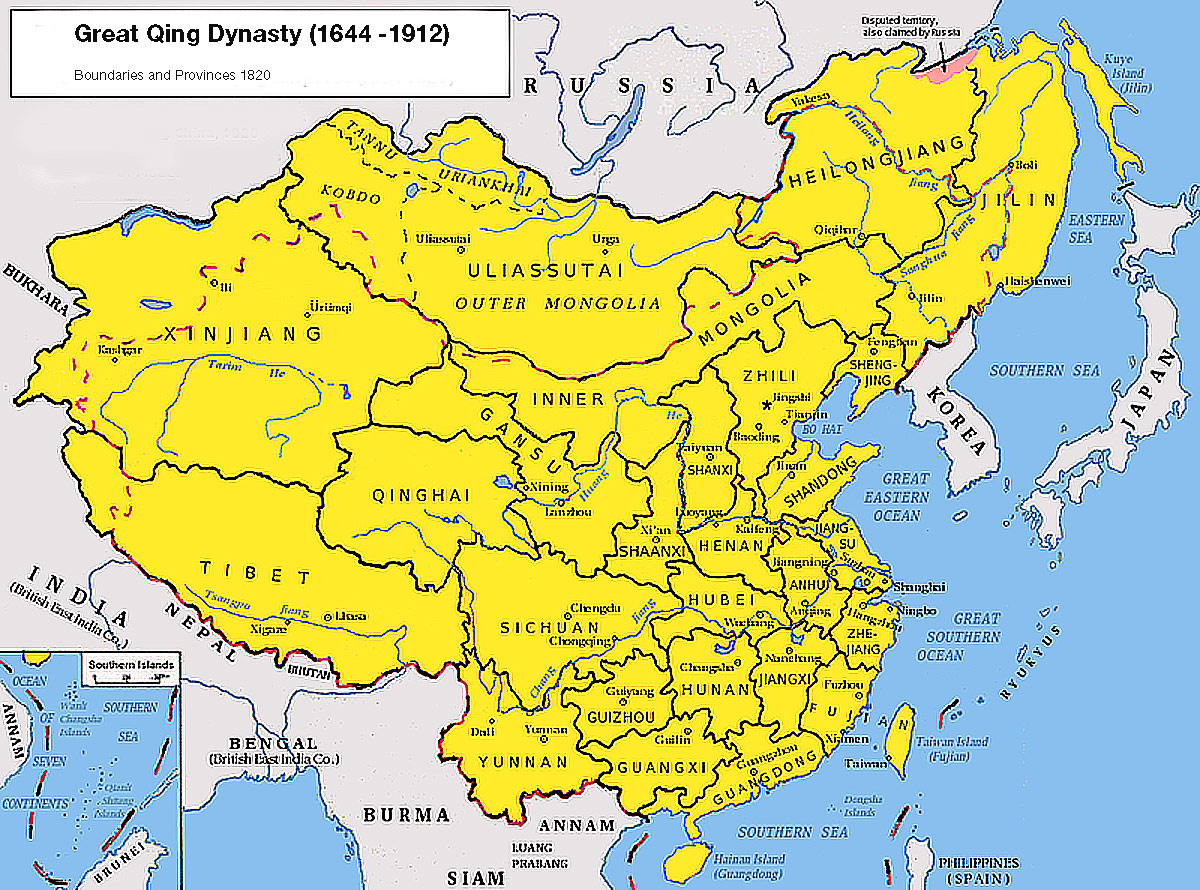
Europe’s leading countries expanded their control over large portions of Asia and Africa in the late nineteenth and early twentieth centuries, putting pressure even on the traditional superpower of East Asia, imperial China. The most devastating blow came in the Opium Wars of 1839-42 and 1856-60, after which Britain imposed unequal treaties on the defeated Chinese and took control of Hong Kong. This humiliation showed all of China’s neighbors and tributaries that the once-mighty China was weak and vulnerable.
With its weakness exposed, China began to lose power over peripheral regions. France seized Southeast Asia, creating its colony of French Indochina. Japan stripped away Taiwan, took effective control of Korea (formerly a Chinese tributary), and also imposed unequal trade demands in the 1895 Treaty of Shimonoseki.
By 1900, foreign powers including Britain, France, Germany, Russia and Japan had established “spheres of influence” along China’s coast – areas in which the foreign powers essentially controlled trade and the military, although technically they remained part of Qing China. The balance of power had tipped decidedly away from the imperial court and toward the foreign powers.
Internal Factors:
While external pressures chipped away at Qing China’s sovereignty and its territory, the empire also began to crumble from within. Ordinary Han Chinese felt little loyalty to the Qing rulers, who were Manchus from the north. The calamitous Opium Wars seemed to prove that the alien ruling dynasty had lost the Mandate of Heaven and needed to be overthrown.
In response, the Qing Empress Dowager Cixi clamped down hard on reformers. Rather than following the path of Japan’s Meiji Restoration, and modernizing the country, Cixi purged her court of modernizers.
When Chinese peasants raised a huge anti-foreigner movement in 1900, called the Boxer Rebellion, they initially opposed both the Qing ruling family and the European powers (plus Japan). Eventually, the Qing armies and the peasants united, but they were unable to defeat the foreign powers. This signaled the beginning of the end for the Qing Dynasty.
The crippled Qing Dynasty clung to power for another decade, behind the walls of the Forbidden City. The Last Emperor, 6-year-old Puyi, formally abdicated the throne on February 12, 1912, ending not only the Qing Dynasty, but China’s millennia-long imperial period.
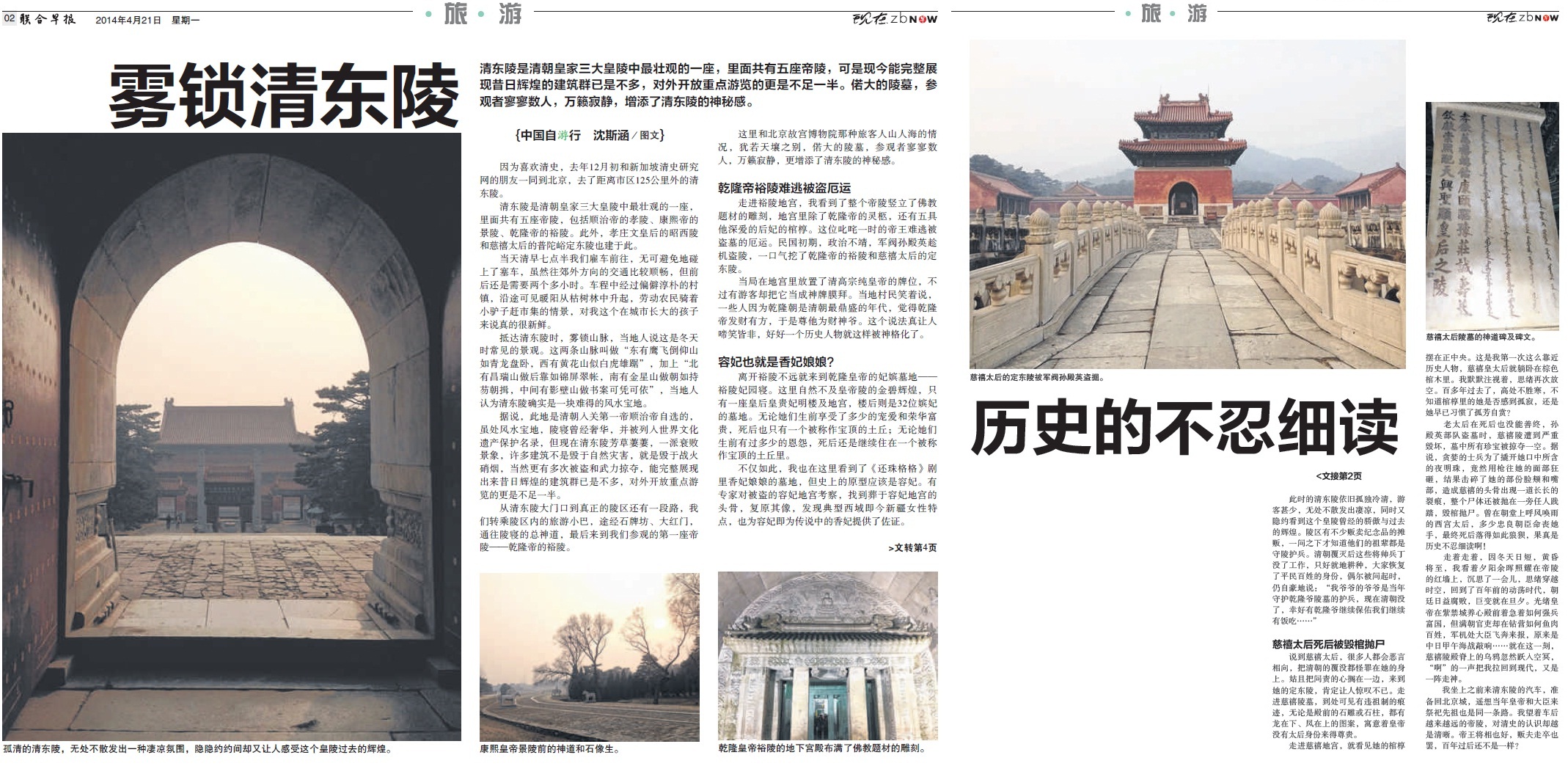
《联合早报》副刊·第2及4版·2014年4月21日·
祝:马年吉祥,阖家安康!Happy Chinese New Year 2014!
 新加坡清史研究学会